Kategorien
Neuester Blog
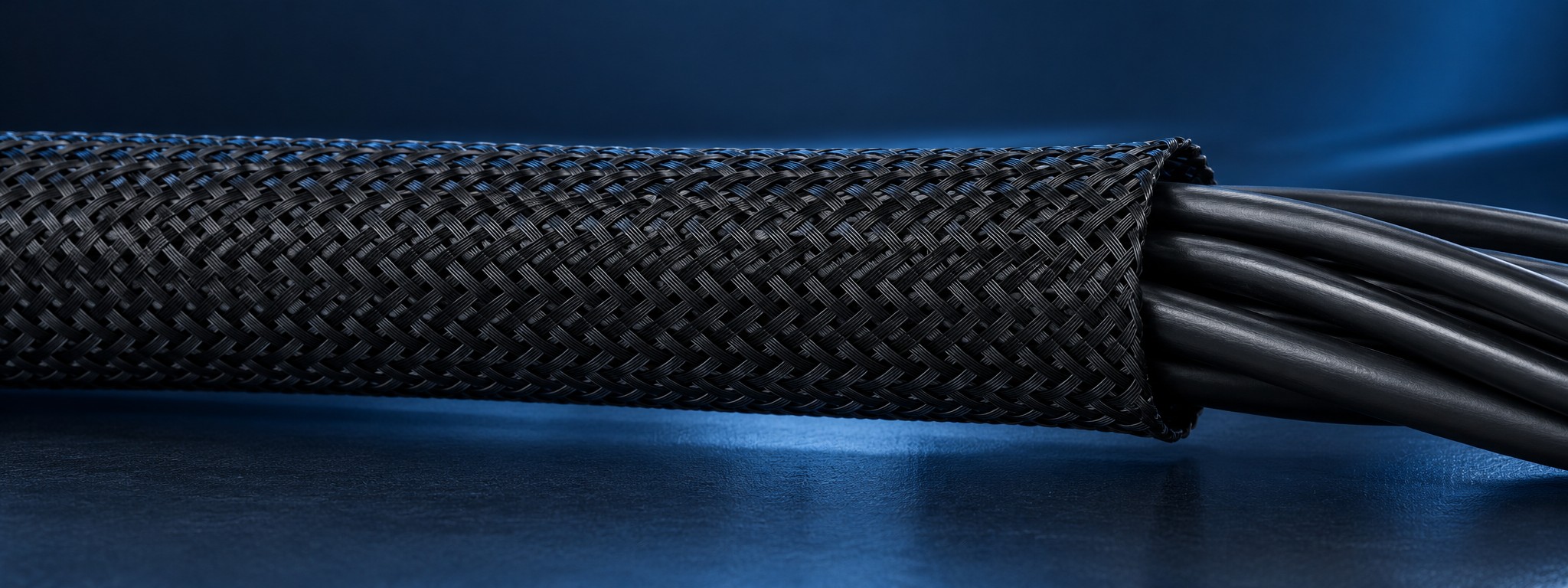
Industrial cable bundles are often exposed to abrasion, vibration, heat, and repeated handling during maintenance. When flame retardancy is also required, selecting the right braided sleeving involves more than comparing flame ratings.
The best choice depends on the installation conditions, required protection, and supporting product documentation.
1. Flame Retardant PET Expandable Braided Sleeving
Best for: General Industrial Cable Bundling and Abrasion Protection
Flame retardant PET expandable braided sleeving features a lightweight polyester filament construction. Its expandable braid accommodates different cable bundle diameters within the specified working range and can pass over certain connectors during assembly.What to check:
Installed coverage, operating temperature, abrasion performance, and relevant flame test reports. As the sleeve expands in diameter, the braid opens and its length can shorten. Confirm the size using an installed sample rather than relying on maximum expansion alone.
2. PET Braided Sleeving with Documented UL 94 V-0 Performance
Best for: Projects That Specifically Require UL 94 V-0
When an equipment specification calls for UL 94 V-0, select a product with supporting evidence that matches the requirement.What to check:
Whether the report supports the product being supplied. A raw material classification should not automatically be treated as certification of every sleeve made from that material.
V-0 performance also does not establish temperature resistance, chemical compatibility, or abrasion durability. These properties require separate assessment.
3. Braided Sleeving with Documented VW-1 Performance
Best for: Cable Protection Projects Specifying VW-1
VW-1 is a flame test designation encountered in wire, cable, and sleeving specifications.
VW-1 and UL 94 V-0 are different test designations. They should not be treated as interchangeable or ranked on a simple “better versus worse” scale. Select the performance required by the project.
4. Flame Retardant Self-Wrapping Braided Sleeving
Best for: Pre-Terminated Harnesses, Retrofits, and Maintenance Access
Closed expandable sleeving must be threaded over the cable bundle from one end. This can be difficult when connectors are already installed or when an existing harness requires additional protection.
What to check:
Overlap around the largest bundle section, closure behavior through bends, retention under vibration, and flame documentation for the exact construction.
5. Specialized High-Temperature Sleeving
Best for: Thermal Exposure Beyond PET’s Documented Operating Range
Cable routes near heaters, ovens, hot piping, or other heat sources may require protection beyond the capabilities of PET sleeving.What to check:
Continuous operating temperature, short-term peaks, radiant heat exposure, coating properties, mechanical durability, and required flame performance.
High-temperature resistance does not automatically establish resistance to prolonged direct flame. Likewise, a flame retardant classification does not demonstrate thermal insulation performance.
How Do the Options Compare?
These options overlap. For example, PET expandable sleeving may have documented V-0 or VW-1 performance, while a self-wrapping construction requires its own supporting evidence.
PET sleeving with documented V-0 performance
Sleeving with documented VW-1
performance
Installation around assembled
harnesses and maintenance access
Thermal exposure beyond PET’s
capabilities
Sleeving Option
Main Reason to Consider It
Key Selection Check
Flame retardant PET expandable Sleeving
General cable organization and abrasion protection
Installed coverage and operating temperature
A specified UL 94 V-0 requirement
Scope of the supporting evidence
A specified VW-1 requirement
Applicable report and tested construction
Flame retardant self-wrapping sleeving
Overlap and closure retention
Specialized high-temperature sleeving
Thermal and flame performance assessed separately
What Should Buyers Specify?
7. Supply format: Roll length, cut length, color, and packaging.
If the application includes smoke, halogen content, or other chemical requirements, specify them separately. A flame test result alone does not establish these properties.
Validate the Sleeve on the Actual Cable Assembly
Before approving production supply, install a sample on a representative cable bundle.
This evaluation can reveal fit and installation issues that nominal dimensions and datasheet comparisons may miss.
FAQ
1. Is flame retardant PET sleeving suitable for every industrial environment?
2. Is a higher flame rating always the best choice?
Select the performance required by the project. Different test methods are not necessarily directly comparable, and flame performance is only one part of the selection process.
3. Can braided sleeving replace electrical insulation or sealed conduit?
Open braided sleeving should not be assumed to provide electrical insulation or sealing. Where these functions are required, use products specifically designed and verified for them.
4. Should I choose expandable or self-wrapping sleeving?
Expandable sleeving is useful when it can be threaded over the bundle during assembly. Self-wrapping sleeving is useful when connectors are already installed or lateral access is needed for maintenance.
Explore Industrial Sleeving Solutions with MJ FLEX
MJ FLEX offers flame retardant PET expandable and self-wrapping sleeving options for industrial cable protection.
Share your cable bundle dimensions, installation conditions, operating temperatures, and required flame test. Our team can help you compare suitable constructions and provide relevant technical documentation and samples for evaluation.




 Deutsch